


Can your asset list keep up with the growth rate of your exposure? |
| Source: Juming Network Published: 2026-11-24 Views: |
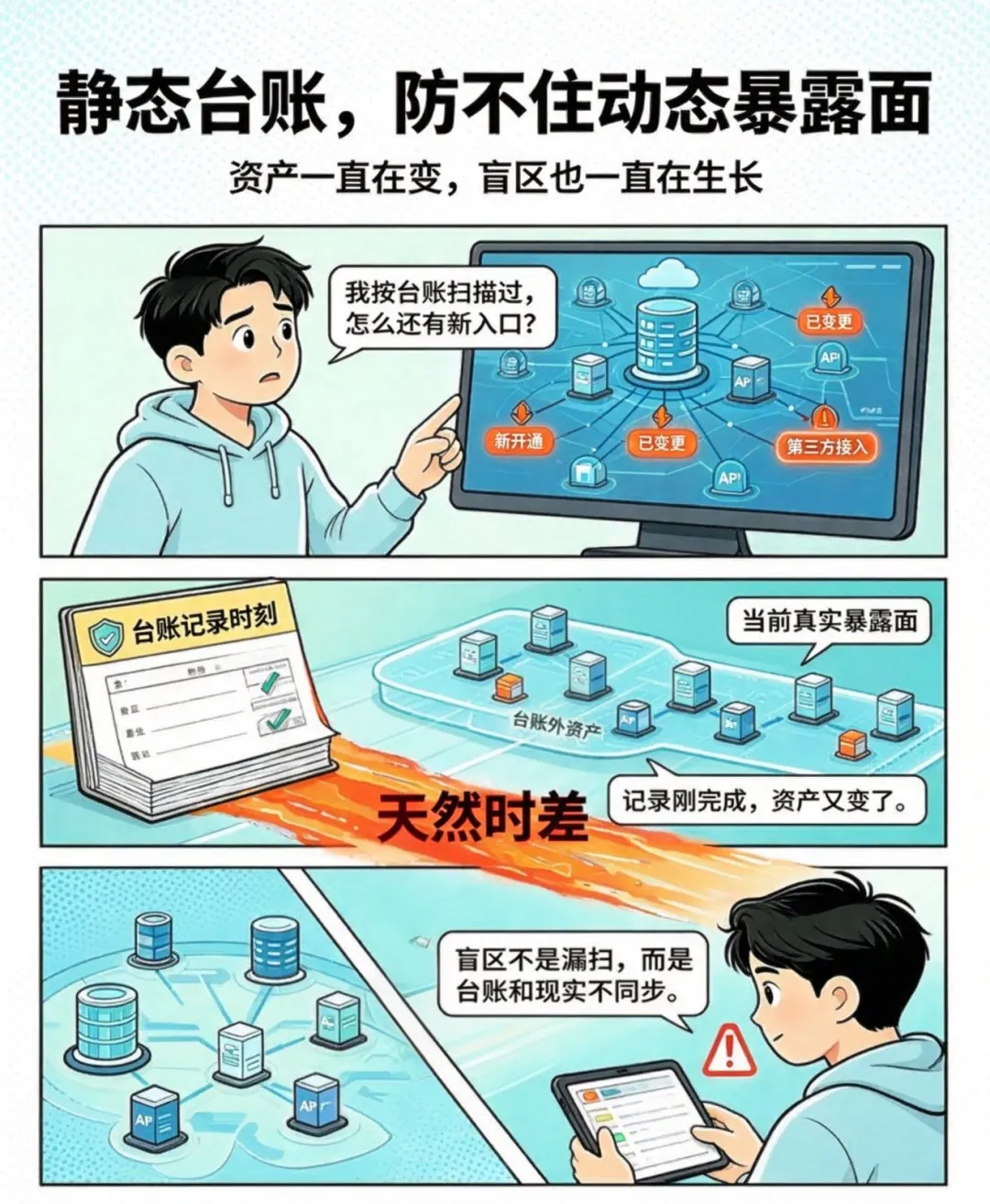
"Is a static asset inventory really enough to build your defenses on?" For a long time, many enterprises have based their security governance — protection, scanning and hardening — on a fixed asset list. But as cloud resources are provisioned elastically, business iterates rapidly, and outsourced and third-party systems keep connecting, the creation, change and decommissioning of digital assets has long since outpaced manual control. An inventory records the state of a single moment, while an enterprise's internet exposure is always growing dynamically. The inherent time lag between the two is exactly the security blind spot attackers wait to exploit.
PART.01 What is attack surface monitoring?
Attack surface monitoring is a security capability that, from an attacker's perspective, continuously discovers, identifies and assesses the risk of an enterprise's digital assets. It differs fundamentally from conventional vulnerability scanning: vulnerability scanning looks for flaws in a known asset list, whereas attack surface monitoring answers first and foremost the question — what assets of yours can actually be seen, accessed and exploited from the internet? Its coverage spans four dimensions: 1、Asset discovery and mappingThis covers internet domains, subdomains, web applications, admin entry points, mobile apps, mini-programs, API endpoints, and elastic cloud resources. The challenge is not running a single scan, but continuously discovering newly added shadow assets that never made it into the inventory — for example test environments set up privately by business units, cloud hosts opened up temporarily, and forgotten legacy systems. These are the entry points attackers most often exploit. 2、Exposed services and configuration flawsHigh-risk ports (unauthorized-access services such as Redis, MongoDB and Elasticsearch), weak passwords or login entry points without MFA on admin panels, debug interfaces left open, directory listings that can be traversed, and overly permissive CORS configurations. What these have in common is that they do not necessarily correspond to any CVE, yet they directly constitute an exploitable attack surface. 3、Data and sensitive information leakageID numbers, mobile numbers, API keys and tokens on public pages; credentials hard-coded in code repositories (GitHub, GitLab and the like); enterprise-related data circulating on cloud drives and the dark web. Such exposure often triggers no alert from any security device, yet it is the most valuable "key" to an attacker. 4、Lateral exposure between internal security domainsThe exposed surface is not confined to the internet boundary. Overly permissive internal access control policies, development and test environments deployed alongside production, and O&M channels that have not been tightened — once the boundary is breached, these internal exposures become the accelerator for an attacker's lateral movement.
PART.02 Why is attack surface monitoring indispensable? 1、Closing asset management blind spots Elastic resource provisioning on the business side, systems built up temporarily, and legacy assets forgotten and left online often fall outside standardized change processes, and are hard to cover by manual inventory alone. Attack surface monitoring continuously maps from the attacker's perspective, proactively capturing shadow assets that exist outside the inventory and bringing invisible assets into the scope of control — effectively filling the blind spots of traditional asset management. 2、Moving the security defense line forwardAn attacker's intrusion chain usually starts with reconnaissance and mapping: first hunting for exploitable exposure entry points, then launching the penetration attack. Routine attack surface monitoring spots those entry points ahead of the attacker, turning security work from after-the-fact incident response into before-the-fact risk governance, and so keeping the defensive initiative. 3、Meeting compliance and real-world exercise requirementsWhether for classified protection (MLPS) assessment, regulatory inspections by competent authorities, or red-team/blue-team exercises, shadow assets and internet exposure governance are core inspection items. A full asset inventory, risk ledger and remediation record built up through continuous monitoring enables an enterprise to complete self-inspection, inspection readiness and after-action review efficiently, systematically reducing the weak points a red team can exploit and lowering the risk of being breached in a live exercise.
PART.03 Juming MSS Security Operations Service: 7×24 continuous attack surface monitoring
Targeting enterprise internet assets, the Juming MSS security operations service provides SaaS-based attack surface security management: a team of security operation experts works in concert with a cloud engine to continuously monitor asset and risk changes 7×24, covering the full chain from asset discovery and risk identification to continuous monitoring. With "tools + experts" as a dual safeguard, it helps enterprises gain full visibility into external assets and potential risks, and drives exposure governance from periodic health checks toward routine operations. 1、Full-domain internet asset mappingAutomatic discovery of websites, domains, subdomains, web applications, admin entry points, mobile apps, mini-programs, official accounts, Weibo accounts and internet port services, building a complete picture of the enterprise's internet assets. Drawing on continuous mapping results, the security service team dynamically updates the enterprise's asset ledger and surfaces shadow assets that sit outside management. 2、Website security risk monitoringMonitoring for black-hat links, hidden links, web page Trojans and high-risk ports as well as high-risk vulnerabilities on the site. The security service team follows up risk leads in real time, promptly identifying the risk of website defacement and exploitation, and preventing compliance notifications triggered by website content security issues. 3、Sensitive information leakage monitoringContinuously probing for exposure risk of ID numbers, email addresses, mobile numbers, API keys and tokens on public pages. Through engine rule matching and expert review, potential data leakage hazards are detected in good time, preventing cascading intrusion caused by credential leakage. 4、Code and cloud drive leakage monitoringMonitoring public code repositories (e.g. GitHub, Gitee), cloud drive shares and enterprise-related information. Source code, configuration files, internal credentials and other potential leakage risks are accurately identified, and blocked before hackers can make use of these "keys". 5、Dark web risk monitoringSecurity service experts keep watch on leakage information and risk leads relating to the enterprise on the dark web. This extends the reach of monitoring into deep waters that conventional scanners cannot touch, helping identify potentially deeper data leakage incidents and detect criminal-industry activity early. 6、Site availability monitoringContinuous monitoring of website access status and availability, detecting site anomalies in good time (e.g. resolution failure, service outage, response timeout), helping safeguard stable operation of internet business and holding the bottom line of business continuity.
Today, with boundaries increasingly blurred and attack techniques constantly evolving, a static asset inventory can no longer cope with dynamic threats. Security strategy needs to shift from passive blocking to continuous visibility and dynamic reduction. Attack surface monitoring is precisely the enterprise's "watchtower" facing the internet: by continuously clarifying every entry point it exposes externally, promptly clearing idle and ineffective assets, and closing the loop on all kinds of high-risk issues, it keeps compressing the infiltration space available to attackers and helps enterprises fortify the first line of digital security. To obtain the continuous attack surface monitoring operation service proposal, please contact us.
|
|
Prev: 2026年11月27日聚铭安全速递 |